Content Section

Articles
Countries and markets 1/2026: Latin American southern cone gains momentum as a growth market for Finnish companies

The Puerto Madero district, developed on the old port area, is part of the commercial center of Argentina’s capital, Buenos Aires.
Published date
Amid geopolitical uncertainty, South America is emerging as an increasingly attractive export market for Finnish companies. The planned EU–Mercosur free trade agreement and improving political and economic conditions in Southern parts, Argentina, Paraguay and Chile, are strengthening the region’s appeal. The significance is also influenced by the geopolitical competition between China and the United States. Finnish products and services have long been in demand, but a more stable business environment and improved financing conditions are now making transactions easier to execute. Energy, mining, and telecommunications are top industries that also peak in Finnvera’s export credit exposure in the region.
Argentina offers significant opportunities in energy, mining, and telecommunications between 2024 and 2027, but political risk remains considerable because of the election cycle and polarized politics. Paraguay and Chile provide greater stability within the regional landscape.
Argentina’s economic shift enables trade - Political risk and relations to China and USA elevate uncertainty
Argentina, in particular, has drawn attention following President Javier Milei’s rapid shift toward market-
oriented economic policies. For years, weak public finances and political volatility complicated business despite underlying demand. Today, improved market conditions and the removal of currency controls have reduced political risk and expanded access to export finance.
The Milei administration has implemented sweeping market reforms, sharply reduced inflation and restoring confidence among international institutions and investors. At the same time, domestic political tensions have intensified, potentially slowing structural reforms, before positive results will materialize.
With the 2027 presidential election approaching, risks remain significant, driven by reform fatigue, social resistance, and exchange-rate pressures.
Although Milei has distanced Argentina politically from China, Chinese investment particularly in energy and mining continues. China remains Argentina’s second-largest trading partner after neighbouring Brazil, with the United States close behind. Meanwhile, the United States has strengthened its influence through IMF cooperation and political support, contributing to financial stabilization efforts.
Argentina’s position between two major powers creates both opportunity and strategic uncertainty.
Energy and mining drive growth in Argentina, Chile as well as Paraguay
Mining and energy, alongside agriculture, are the region’s key growth engines. Foreign interest in Argentina has increased substantially, supported by the Vaca Muerta oil and gas field and extensive lithium and other critical mineral reserves. Following the reopening of financial markets and the lifting of capital controls, foreign companies have slowly regained confidence and accelerated investments. Energy investments alone are estimated to have reached approximately USD 15 billion in 2025, with mining close behind. Investment has also been encouraged by the RIGI incentive framework for large-scale projects.
In Chile, copper and lithium remain economic cornerstones despite constraints such as water scarcity and declining ore grades. Long-term global demand for critical minerals supports strong market prospects.
Paraguay, for its part, offers stable conditions and climate-focused policies that favour forest industry and energy investments.
Telecommunications on the rise – in forestry more competition between countries
Argentina’s telecommunications sector is benefiting from capital market liberalization and regulatory reforms. Increased foreign investment is creating demand for infrastructure and digitalization solutions. The country already has a dynamic SME ecosystem in digital services, which stands to gain from improved financial stability.
Although Argentina is not a leading forestry producer compared with Brazil, Chile, and Uruguay, trends in the bioeconomy and renewable energy create opportunities for Finnish technology and equipment suppliers.
Forestry investments require long-term stability. Paraguay has emerged as a regional hotspot, with its first pulp mill investment underway and additional projects planned. Argentina is still seeking to strengthen long-term investor confidence in its largely untapped forest resources.
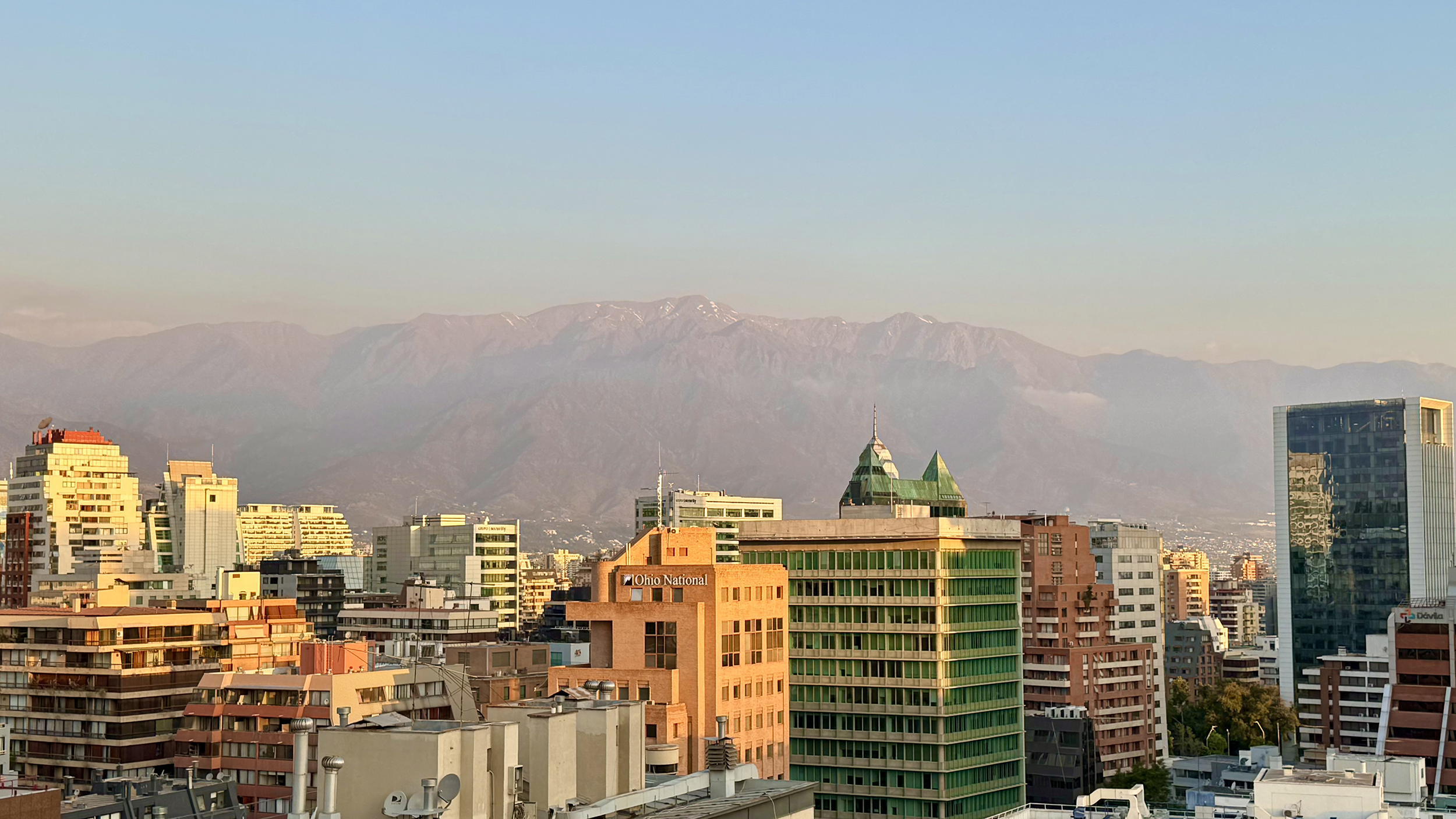
Strong global demand for Chile's critical minerals continues to attract investments. Capital city Santiago in the picture.
Economic outlook is good with the EU–Mercosur agreement ahead
Argentina’s economy is gradually recovering, with growth projected at around 3% in 2026 and onwards. However, exchange-rate volatility and political uncertainty continue to pose risks. Rebuilding investor confidence remains challenging after decades of economic turbulence.
Paraguay has been one of the region’s most stable economies, growing steadily for two decades apart from the pandemic years. Growth is expected to remain near 4% annually, supported by foreign investment, and its currency has been most stable in the region.
Chile, often considered the region’s most politically stable economy, is pursuing growth through mining, renewable energy, and an emerging hydrogen sector. Strong global demand for critical minerals continues to attract investments.
The EU and Mercosur landmark trade deal would gradually eliminate over 90% of tariffs. The agreement includes stronger sustainability commitments, while granting Mercosur countries greater industrial policy flexibility. Although ratification has faced delays due to legal review in the EU side, the commercial provisions may be applied provisionally in line with the EU Commission’s decision. Over time, the agreement would enhance market predictability and openness. Reduced tariffs on industrial goods and machinery would benefit Finnish suppliers in energy, mining, and telecommunications infrastructure and also expand access to public procurement markets.
This is how Finnvera guarantees exports
Argentina falls under category C in Finnvera’s country policy. This means that Finnvera can provide export credit guarantees on a case‑by‑case basis, depending on the size of the transaction, the counterparty, the securities, and the overall analysis. Paraguay is also classified as category C, although the country’s payment capacity is stronger. Chile is classified as an advanced economy, and the country policy applied there is flexible.
Finnvera's country classification map.
For more information on financing opportunities, please contact Senior Adviser Mika Relander.
Author:
Senior Adviser Mika Relander is responsible for Finnvera’s country risk management in Latin America and Caribbean.
Read also:
Share page: